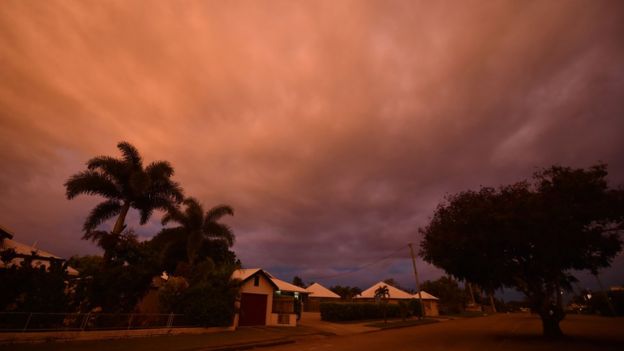
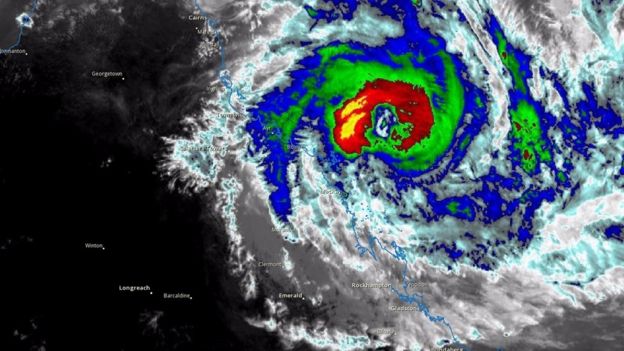
A powerful cyclone carrying winds of up to 263km/h (163 mph) has reached the coast of Queensland, Australia.
More than 25,000 people were urged to evacuate ahead of Cyclone Debbie.
The category four storm has already left at least 23,000 homes without power and caused damage on the popular Whitsunday Islands.
The slow-moving cyclone, expected to be Queensland’s most damaging since 2011, is likely to remain over the state for hours, authorities warned.
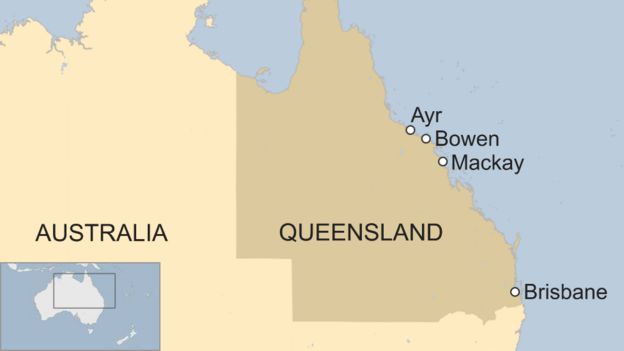
The storm made landfall between Bowen and Airlie Beach, Queensland Police said.
“We are in for a long, tough day,” said Queensland Premier Annastacia Palaszczuk.
“The intensity and ferocity of the winds is going to be gradually increasing. Everyone is bunkered down.”
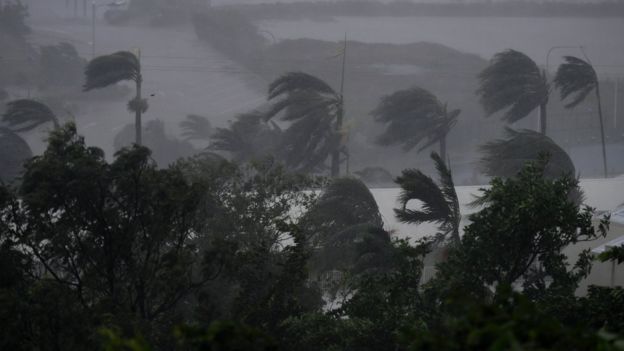 Image captionCyclone Debbie could be the most powerful storm to hit the area since Cyclone Yasi in 2011
Electricity providers said more homes would lose power.
“We’re getting reports of roofs starting to lift, even in some of our own facilities in the Whitsundays,” said Queensland Police Deputy Commissioner Steve Gollschewski.
One person in the region compared the winds to “freight trains coming through left and right”.
“The trees are going wild. The place is just shaking continuously,” the man, identified only as Charlie, told the Australian Broadcasting Corp.
View from Townsville – Hywel Griffith, BBC News
What is normally a bustling gateway to the Great Barrier Reef has ground to a halt in preparation. Forecasts suggest Townsville may not be hit directly by the storm’s core, but winds have already picked up and no-one is taking chances.
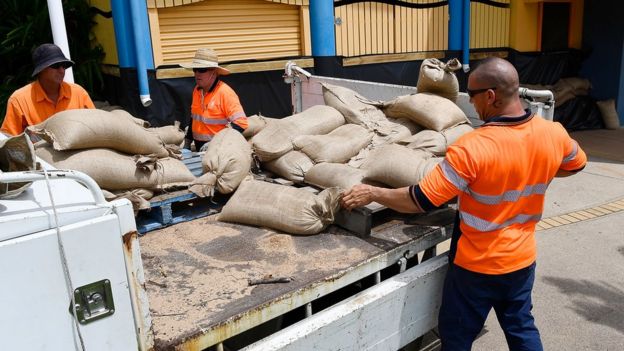
Most businesses have shut up shop – some have sandbags lining the doorway. The few coffee shops that have opened are doing a roaring trade. Lines of police officers and firefighters are getting a heavy dose of caffeine to prepare for the long day and night ahead.
Many tourists seem to have moved on, or cancelled their visit completely – one hotelier told me they had lost thousands of dollars in bookings.
Even if Townsville is spared the worst of Cyclone Debbie, it is already feeling the impact.
Test of endurance
Forecasters had twice delayed predictions of when the cyclone would make landfall.
Ms Palaszczuk described the storm as “a monster” and compared it to Cyclone Yasi, which had devastated towns and flooded evacuation centres.
She said Monday’s emergency evacuation order was “probably the largest ever” for the north-eastern state.
In other key developments:
-
Forecasters said the tidal surge would now be less than 2m (6ft), and no longer coincide with high tide
-
However, authorities warned there would still be flooding in low-lying areas
-
The region is expected to be hit with 150-500mm of rain on Tuesday
-
Police warned people to beware of fallen powerlines, which could be deadly
-
Emergency stockpiles of food and fuel have been set aside, and the army is on standby