North Korea has claimed that the missile it tested on Sunday was a new type of rocket capable of carrying a large nuclear warhead.
The missile, launched at a steep angle, reached an altitude of 2,000km (1,242 miles) and travelled about 700km, landing in the sea west of Japan.
North Korea said on Monday it was a test of the abilities of a “newly developed ballistic rocket”.
The test, yet another breach of UN sanctions, was roundly condemned.
Repeated missile tests by the North this year – not all of them successful – have sparked international alarm and raised tensions with the US.
The US and Japan have called for an emergency meeting of the UN Security Council on Tuesday.
North Korea’s KCNA state news agency said on Monday that the test of a “newly developed mid/long-range strategic ballistic rocket, Hwasong-12” had gone to plan.
“The test-fire aimed at verifying the tactical and technological specifications of the newly developed ballistic rocket capable of carrying a large-size heavy nuclear warhead,” it said.
North Korea is known to be developing both nuclear weapons – it has conducted five nuclear tests – and the missiles capable of delivering those weapons to their target. Both are in defiance of UN sanctions.
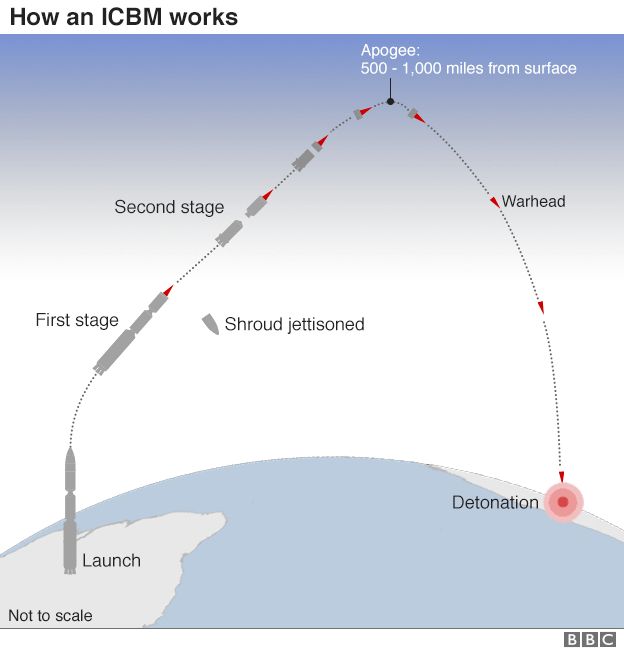
But it remains unclear whether it has the ability to make the weapons small enough to be mounted on a rocket, and it has never tested a long-range intercontinental ballistic missile (ICBM) which could reach, for example, the US.
ICBM’s are considered to have a range of about 6,000km, but analysts believe the missile tested on Sunday would have travelled about 4,000km if it had been fired at a standard trajectory rather than upwards.