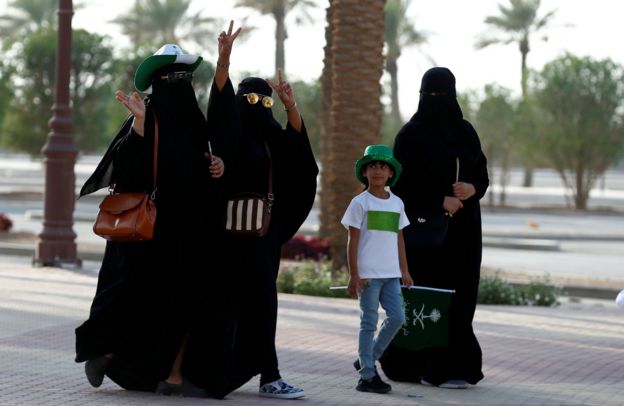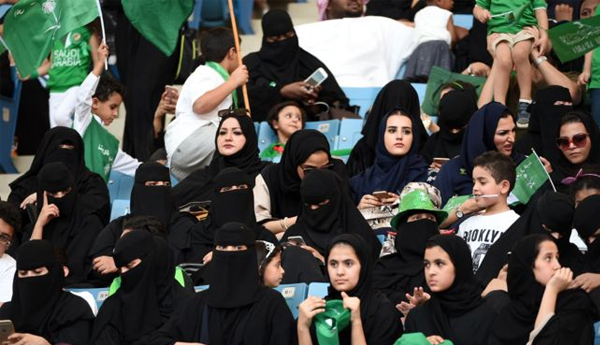
The Saudi government is facing a backlash on social media after allowing women to participate in its National Day celebrations for the first time.
The festivities included fireworks, light shows and a concert in King Fahd International Stadium in the capital, Riyadh, on Saturday evening.
Women were allowed in the stadium in a specific section for families.
The staunchly conservative Islamic kingdom is known for its strict gender segregation rules.
Saudi Arabia is marking the 87th anniversary of its founding, an event instituted by the late King Abdullah as a national holiday in 2005.
This year’s celebrations are part of Crown Prince Mohammed bin Salman’s Vision 2030 plan, which aims to reduce the kingdom’s dependence on oil and promote domestic industry and tourism.
Organised by the newly established Entertainment Authority, celebrations also featured street rallies, singing and dancing.
Under Saudi law, which enforces a strict form of Sunni Islam known as Wahhabism, women must wear loose-fitting, full-length robes known as “abayas” in public, as well as a headscarf if they are Muslim.
They are also banned from driving, must not associate with unrelated men and must be accompanied by or receive written permission from a male guardian – usually a father, husband or brother – if they want to travel, work or access healthcare.
‘Patriotism does not mean sin’
Although the events were heavily promoted by state media, social media reaction was more polarised.
Despite thousands of messages in support of the national show of patriotism, critics condemned the involvement of women.
“Patriotism does not mean sin. Of course, what is happening does not please God and his prophet. Patriotism is not dancing, free mixing, losing decency and playing music. What strange times,” tweeted one user.
The tweet promoted others to use the hashtag “patriotism does not mean sin” to echo a similar message.
-
Women have ‘quarter of brain’ says Saudi cleric
-
Saudi Arabia investigates video of woman in miniskirt
-
Saudi Arabia’s religious police ordered to be ‘gentle’