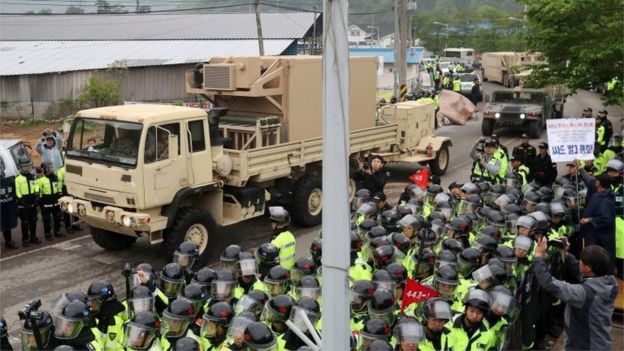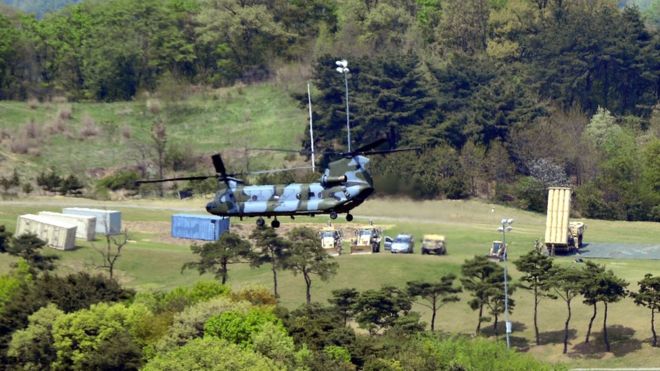
An advanced US missile system being installed in South Korea will be operational “within days”, the US Army has said.
The Thaad system is designed to protect South Korea and US troops based there against threats from North Korea.
The first key components were moved into place on Wednesday, but it was not expected to be in use until late 2017.
The deployment of the system is opposed by many South Koreans, who fear it will become a target, and by China.
Speaking to members of the US Congress on Wednesday, Adm Harry Harris, commander of the US Pacific Command, said Thaad would be “operational in the coming days to be able to better defend South Korea against the growing North Korea threat”.
He has said the system is designed to bring North Korean leader Kim Jong-un “to his senses, not to his knees”.
-
How mixed signals on North Korea could spell disaster
-
What can the outside world do about N Korea?
-
US to tighten sanctions on North Korea
-
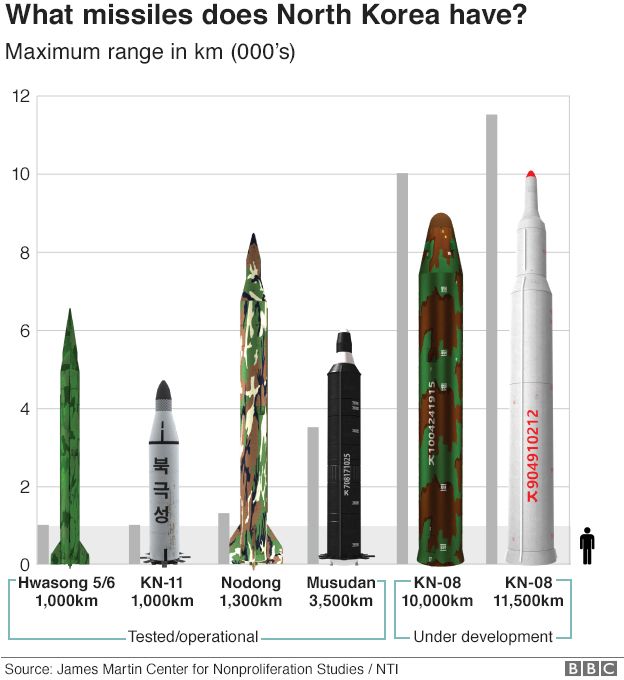
North Korea’s missile programme
South Korea’s defence ministry later confirmed the system would soon be “in actual operation” soon, at its site on a former golf course in Seongju in eastern South Korea.
A spokesman said the “positioning of some equipment means that South Korea and the US have the capability to cope with North Korea’s provocations”.
What is Thaad?
What is the Terminal High Altitude Area Defence System (Thaad)?
-
Shoots down short- and medium-range ballistic missiles in the terminal phase of their flight
-
Uses hit-to-kill technology – where kinetic energy destroys the incoming warhead
-
Has a range of 200km (120 miles) and can reach an altitude of 150km
-
US has previously deployed it in Guam and Hawaii as a measure against potential attacks from North Korea
-
Deployment to South Korea was agreed by Obama administration