The United Nations has imposed a fresh round of sanctions on North Korea after its sixth and largest nuclear test.
The measures restrict oil imports and ban textile exports. The latter is aimed at starving the North of income for its weapons programmes.
The US had originally proposed harsher sanctions including a total ban on oil imports.
The vote was only passed unanimously after Pyongyang allies Russia and China agreed to the reduced measures.
The sanctions, which were passed at a UN Security Council meeting on Monday, were met with anger by North Korea.
A statement on state news agency KNCA called the US a “bloodthirsty beast obsessed with the wild dream” of reversing Pyongyang’s nuclear programme. It warned that if the US did eventually push through harsher sanctions, North Korea would “absolutely make sure that the US pays due price”.
Media captionHow would war with North Korea unfold?
The US had called for the harshest ever sanctions on North Korea including a total ban on oil imports, a measure seen by some analysts as hugely destabilising for the regime.
But the new measures instead only place limits on such products. China, Pyongyang’s main economic ally, supplies most of North Korea’s crude oil.
A proposed asset freeze and travel ban on leader Kim Jong-un have also been dropped.
A ban on exports of textiles – Pyongyang’s second biggest export and a significant source of income – and measures to prohibit North Koreans from working overseas will go ahead.
-
North Korea crisis in 300 words
-
How should Trump handle North Korea?
-
How do you defend against North Korea?
The US ambassador to the UN Nikki Haley, told the Security Council after the vote: “We don’t take pleasure in further strengthening sanctions today. We are not looking for war.”
“The North Korean regime has not yet passed the point of no return… If it agrees to stop its nuclear program, it can reclaim its future.”
Monday’s resolution was the ninth one unanimously adopted by the UN since 2006.
Testing North Korea with sanctions
-
30 November 2016: UN slapped sanctions on North Korea over its nuclear programme, targeting its valuable coal trade with China, slashing exports by about 60% under a new sales cap. Exports of copper, nickel, silver, zinc and the sale of statues were also banned
-
What happened next? On 14 May 2017, North Korea tested what it said was a “newly developed ballistic rocket” capable of carrying a large nuclear warhead
-
2 June 2017: UN placed new sanctions, imposing a travel ban and asset freeze on four entities and 14 officials, including the head of North Korea’s overseas spying operations
-
What happened next? On 4 July, North Korea said it carried out its first successful test of an intercontinental ballistic missile (ICBM). The Hwasong-14, it said, could hit “any part of the world” (US estimates said that this was unlikely)
-
6 August: UN unanimously agrees to the banning of North Korean exports of coal, ore and other raw materials along with limiting investments in the country
-
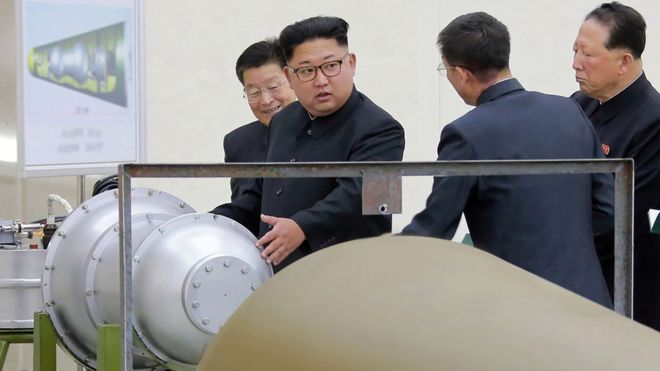
What happened next? On 3 September, North Korea said it had successfully detonated a hydrogen bomb – many times more powerful than an atomic bomb – that can be miniaturised and loaded on to a long-range missile
Read more on Pyongyang’s missile programme
-
North Korea’s missile programme
-
What we know about North Korea test site
-
How advanced is North Korea’s nuclear programme?