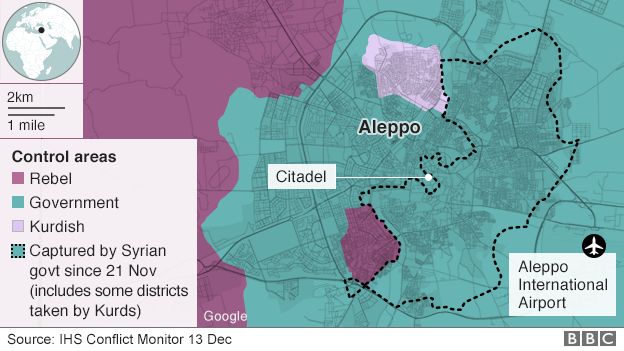
A deal to evacuate the last rebel-held part of eastern Aleppo is back on, opposition fighters say, a day after a previous agreement fell through.
Rebel fighters and civilians in the Syrian city had been due to leave early on Wednesday, but the truce collapsed.
Rebel groups said late on Wednesday that evacuations would take place in the early hours of Thursday.
But there has been no confirmation so far from the Syrian government or its major ally Russia.
And a media unit run by the Lebanese Shia Muslim movement Hezbollah, a backer of the Syrian government, said negotiations were undergoing “big complications” and had not yet concluded.The rebels said the new ceasefire would come into effect late on Wednesday, with evacuations to follow hours later.
The new deal would allow the simultaneous evacuation of two villages being besieged by rebels in north-western Syria.
Syria’s government and its ally Iran had insisted the evacuation from eastern Aleppo could happen only when those villages were evacuated.
-
Jeremy Bowen: The blame game starts
-
How Srebrenica’s survivors view Aleppo
-
What’s happening in Aleppo?
-
What happens next?
On Wednesday morning, buses and ambulances were brought to evacuate rebel fighters and their families – only to be turned away shortly afterwards.
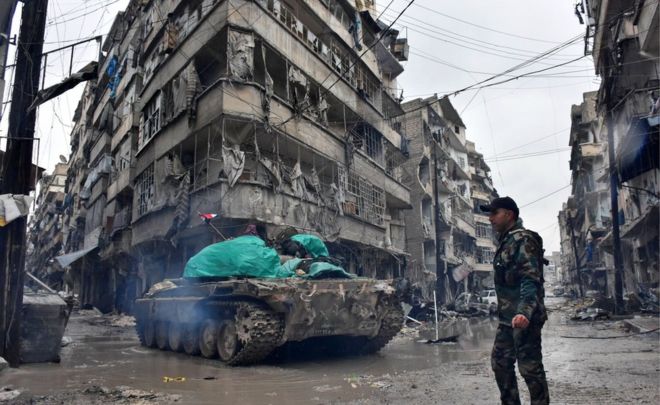
Hours after the first agreement – brokered mainly by Russia and Turkey – collapsed, air strikes resumed over rebel-held territory, where at least 50,000 civilians remain.
The UN said raids by the Syrian government and its allies on an area “packed with civilians” most likely violated international law.
“While the reasons for the breakdown in the ceasefire are disputed, the resumption of extremely heavy bombardment by the Syrian government forces and their allies on an area packed with civilians is almost certainly a violation of international law and most likely constitutes war crimes,” Zeid Raad al-Hussein, the UN High Commissioner for Human Rights, said.
Meanwhile, the BBC has learned that Western forces are using satellites and unmanned aircraft to gather evidence of possible war crimes in Aleppo and elsewhere in Syria.
Most politically sensitive deal – BBC’s Lyse Doucet in Beirut
Many of Syria’s prolonged battles and punishing sieges have ended with a negotiated pullout of rebel fighters.
The day of departure is often marked by delays and new demands. Aleppo is no different.
But this is the most politically sensitive deal of all.
The first deal, largely brokered by Russia and Turkey, appears to have upset Iran, as well as the Syrian government, who felt they did not have enough of a say.
Both insisted, as they have done for aid convoys and evacuations elsewhere, that there must be a simultaneous mission for injured fighters and civilians in the Shia villages of Foah and Kefraya which are besieged by rebel forces.
There have been arguments over other details, too.
No sooner was a second deal announced, denials by players on one side or the other began to emerge.
Only when buses are boarded, and ambulances pull away, can it be said with any certainty that this battle is drawing to a close.
-
Trapped in Aleppo – in pictures
-
‘The most beautiful city in the world’
-
What happened to those who said last goodbyes?