The US military says it has begun deploying a controversial missile defence system in South Korea.
The Terminal High-Altitude Area Defense system (Thaad) is designed to protect against threats from North Korea.
The move to begin installing the system comes a day after the North launched four ballistic missiles, breaking international sanctions.
But its planned deployment has angered many in North and South Korea and around the region.
China is furious at what it sees as an encroachment of US military power, while many South Koreans believe the defence system will become a target, endangering people who live around the military sites.
What is the Terminal High Altitude Area Defense System (Thaad)?
-
Shoots down short and medium-range ballistic missiles in the terminal phase of their flight
-
Uses hit-to-kill technology – where kinetic energy destroys the incoming warhead
-
Has a range of 200km and can reach an altitude of 150km
-
US has previously deployed it in Guam and Hawaii as a measure against potential attacks from North Korea
What impact will S Korea’s expanded missile defence system have?
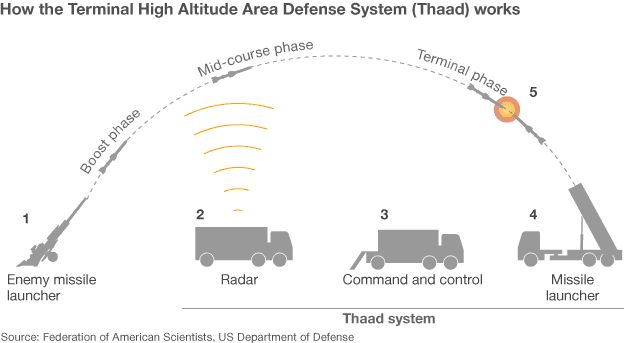
1. The enemy launches a missile
2. The Thaad radar system detects the launch, which is relayed to command and control
3. Thaad command and control instructs the launch of an interceptor missile
4. The interceptor missile is fired at the enemy projectile
5. The enemy projectile is destroyed in the terminal phase of flight
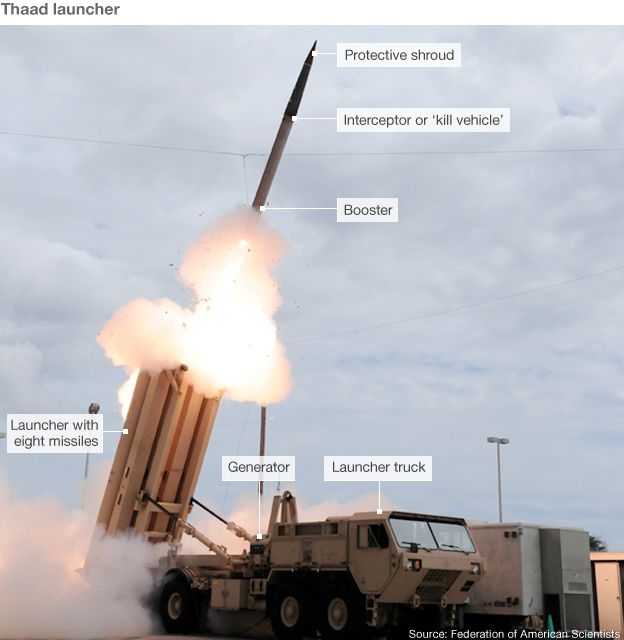
The launcher trucks can hold up to eight interceptor missiles.
Pyongyang had threatened last Friday that it would fire missiles in response to the start of the Foal Eagle US-South Korean military exercises. The annual drills infuriate the North, which sees them as preparation for an invasion from the South.
Then early on Monday, it fired the four missiles from the Tongchang-ri region, near the border with China.
The type of projectile used remains unclear, but three flew some 1,000km (620 miles) and fell into Japan’s exclusive economic zone (EEZ).
-
What is new in North Korea’s missile technology?
-
What will Trump do about North Korea?
-
More on North Korea’s missile programme
-
North Korea’s nuclear tests